
Horse hay wastage is a very real problem that many owners and livery yard managers encounter. It is reported that approximately 30% of hay is lost to wastage in some feeding situations. The actual number varies depending on the feeding method, the environment in which the hay is provided and the horse’s individual behaviour.
Join us in this blog as we outline how much hay a horse wastes a year, how much it is costing owners and what causes horses to waste so much hay.
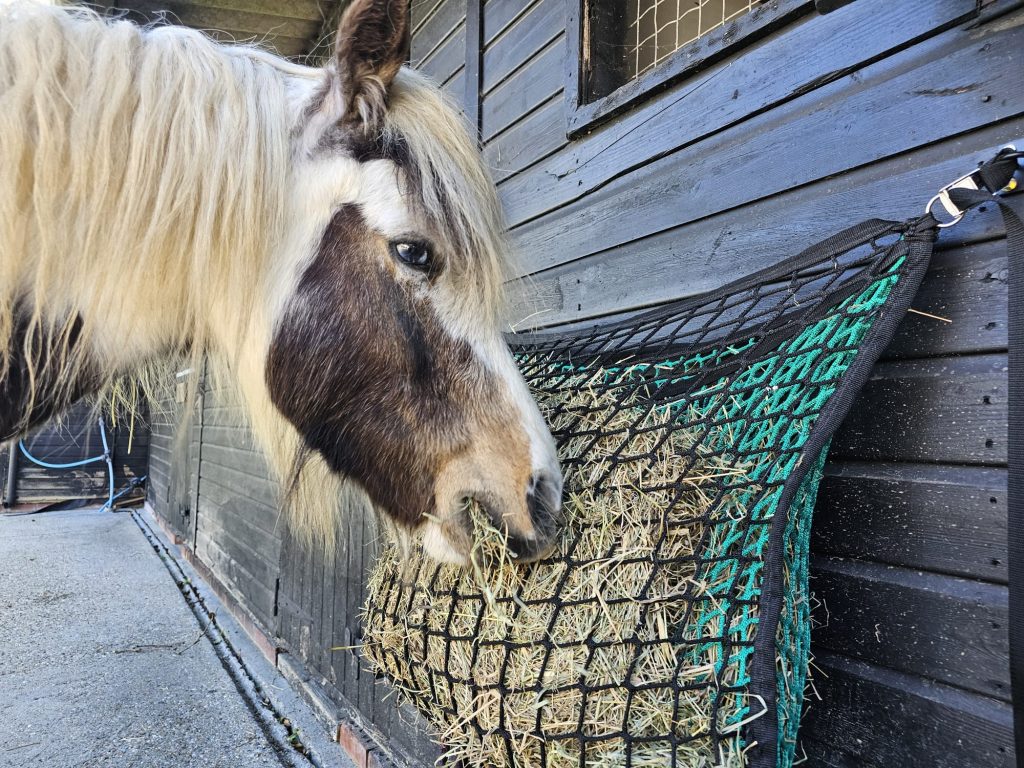
While we recommend monitoring your own horse’s hay consumption and wastage, you will be able to make an estimate as to what percentage of hay is lost each year due to various reasons such as feeding method and storage.
Hypothetically, if your horse is offered 10 kilos of hay per day, every single day, not adjusted depending on time of year, if they waste just 10% of that each year, they are losing out on 365kg of hay annually. That’s the equivalent of 18.3 20kg bales. When you think about how much hay your horse wastes, is it as small as 10%?
| Hay wasted | Annual waste | 20kg bales |
| 10% | 365kg | 18.3 |
| 20% | 730kg | 36.5 |
| 30% | 1,095kg | 54.8 |
Assuming a single 20kg hay bale costs on average £6 per bale, and your singular horse is wasting just 10% of the total hay you’re providing, that is a minimum loss of £109.80 every year. While that might not seem like a lot on the surface, that’s assuming they waste just 10%.
For livery yards with multiple horses, these costs can quickly stack up, making a small loss look pretty substantial in no time. Finding a way to stem this loss of hay is critical to the financial running of livery yards across the UK.
Horses waste hay for a range of reasons. Some are avoidable, some should be expected, and the rest are on the owner to do their part to reduce wastage.
Naturally when foraging, any hay that is loose-fed to the horse could end up being trampled. When it is trampled, it then becomes mixed with mud, bedding, droppings or urine, which ultimately makes it inedible through contamination.
If access to hay on the horse’s part goes largely unregulated, they will naturally pull out larger quantities of hay than they need, leaving loose hay scattered around the feeding area. This is why forage regulation one way or another is important.
When hay becomes damp, isn’t properly stored, or the feeding areas are being overfilled, you should expect to see waste increase. As a horse owner, it is your responsibility to ensure you are doing what you can to store the hay appropriately and don’t overfill feeding areas.
As a horse owner, your main focus is going to be your horse’s welfare. Secondly, it should be about reducing waste in your yard, making it as sustainable as possible financially and from a welfare perspective. So, how can you reduce horse hay wastage?
For a select period of time, you could measure how much hay your horse consumes. Monitoring forage effectively includes noting how much is offered, consumed and discarded. This will give you an idea of how much you should be filling your hay.
Slow-feed hay nets, knotless ones to be specific, are great at helping contain hay, reducing large mouthfuls. This reflects the natural foraging they would do in the wild, thanks to the range of hole sizes to choose from, which improves waste reduction and nutrient intake.
Explore some of the most commonly asked questions around hay wastage and how to reduce it.
Loose ground feeding is naturally going to lose some hay to waste due to the nature of foraging and the environment it is placed in. Using a suitable, low-level containment is a more effective way of mimicking the foraging your horse would do in nature, while restricting waste.
Yes, slow-feed hay nets can reduce hay costs when the most suitable feeder is provided, while also being the best quality. Adequate forage availability is also important.
By reducing your wastage, you can help stretch those budgets further while still prioritising your horse’s forage intake. With Nibbleze slow-feed hay nets, you can effectively reduce hay wastage and manage your horse’s forage intake in one crafty net. With different hole sizes available, there is a net to suit all consumption rates.
For more information, head to our slow-feed hay nets or get in touch with us.